
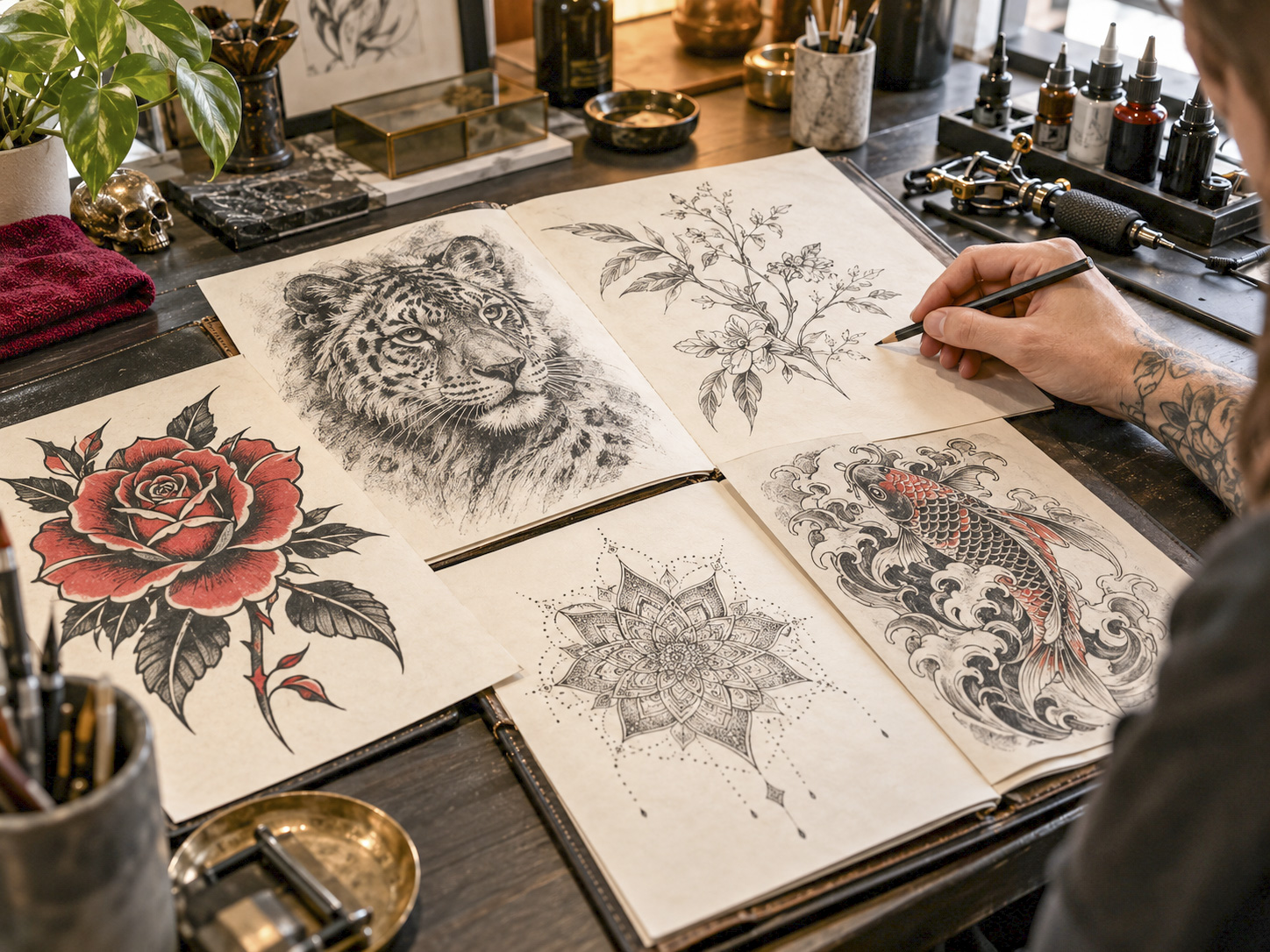
A tattoo’s style shapes how it looks; its technique describes how the artist creates it. Bold outlines, delicate linework, smooth shading, and carefully placed dots can all express very different ideas. Behind those choices are living cultural traditions, visual art influences, and generations of experimentation.
This guide explores major tattoo styles and the techniques associated with them. Many contemporary styles developed gradually across communities, so a single inventor or exact starting date cannot always be identified.
Style, technique, and subject: understanding the difference
A rose is a subject. American Traditional is a style. Linework and color packing are techniques. The same rose could become a traditional flash design, a realistic botanical portrait, or a minimalist outline. Machine tattooing, hand-poking, and hand-tapping describe application methods rather than one particular appearance.
American Traditional: bold outlines and recognizable imagery
American Traditional, also called Old School, is recognizable by strong black outlines, clearly separated shapes, and a relatively restrained palette. Anchors, swallows, hearts, ships, roses, and eagles are familiar subjects. Linework establishes the structure, while solid color and selective shading give the design weight.
The style is closely associated with maritime tattooing, port cities, military communities, and the circulation of ready-to-tattoo flash designs. The U.S. Naval History and Heritage Command documents how sailors helped spread tattooing through ports and naval bases. These connections are part of the history of American Traditional, rather than the origin of tattooing itself.
Neo-Traditional and New School: expanding the traditional vocabulary
Neo-Traditional keeps the strong outlines and readable composition of traditional tattooing while adding richer palettes, decorative detail, and more elaborate shading. Its visual influences often include illustration and ornamental art.
New School moves toward exaggerated proportions, animated expressions, bright colors, and cartoon-like depth. Both styles grew through contemporary tattoo culture rather than a single founding moment. Artists balance detailed imagery with the clear shapes needed to make a design readable on the body.
Japanese Traditional and Contemporary Japanese
Japanese tattooing is associated with large, flowing compositions that unite figures, animals, flowers, water, wind, and other background elements. Its visual vocabulary has strong connections to Japanese printmaking, storytelling, and historical imagery. Traditional compositions often treat an arm, back, or larger body area as one connected design.
Tebori is a Japanese hand tattooing method; it is not another name for every Japanese-style tattoo. Artists also use machines, and some combine application methods. Contemporary Japanese work may reinterpret traditional subjects through different colors, proportions, or graphic treatments.
Realism, portraits, and microrealism
Realistic tattooing draws on the visual language of photography, painting, and observational drawing. Artists build depth through changes in value, soft transitions, selective edges, and carefully planned highlights. Color realism uses hue as well as light and shadow; black-and-grey realism emphasizes tonal relationships.
Portrait realism focuses on likeness, expression, and facial proportions. Microrealism applies a detailed visual approach at a smaller scale. Small scale is not a guarantee of lasting detail: the artist must consider spacing, placement, and how closely grouped elements may read as the tattoo ages.
Chicano tattooing and black-and-grey traditions
Chicano tattooing has important roots in Mexican American communities, particularly in Southern California, including barrio and prison tattooing histories. Common visual elements include expressive lettering, religious imagery, portraits, and scenes reflecting family, identity, and lived experience.
Freddy Negrete is a documented pioneer of professional Chicano and black-and-grey tattooing. Smooth shading and fine detail are important parts of this history, but not every black-and-grey tattoo is Chicano. Color approach and cultural style should remain distinct descriptions.
Fine Line, minimalist designs, and linework
Fine Line emphasizes delicate marks. Minimalism reduces a design to essential shapes, while linework makes the line itself the main visual element. A single-needle setup can be used for fine work, but Fine Line and Single Needle are not interchangeable labels.
These approaches draw from several sources, including drawing, graphic design, and established fine-detail tattoo practices. Their contemporary popularity does not establish one exclusive origin. Artists use spacing, line hierarchy, and restraint to keep simple designs legible.
Blackwork, geometric designs, ornamental work, and dotwork
Blackwork uses black ink as its principal visual material, ranging from detailed patterns to broad solid areas. Negative space—the skin left untattooed—can become an active part of the composition. Contemporary blackwork brings together multiple influences; it should not be treated as one continuous cultural tradition.
Geometric tattoos organize shapes and relationships. Ornamental designs emphasize decorative flow; mandala designs use radial organization. Dotwork builds texture and tonal variation through dots, with denser areas appearing darker. Stippling has parallels in drawing and printmaking, and dot-based tattoo effects can be made with machines or by hand.
Lettering and script
Lettering tattoos draw from calligraphy, typography, sign painting, graffiti, and community-specific lettering traditions. Script, Gothic or Blackletter, and Chicano lettering each bring different visual associations.
The artist considers letter spacing, stroke thickness, placement, and how a phrase follows the body. A lettering tattoo can also incorporate illustrative or ornamental elements without losing its typographic foundation.
Watercolor, sketch, abstract, and graphic styles
Watercolor tattoos imitate the visual effects of painted washes, loose edges, and overlapping color. The effect comes from tattoo application; watercolor paint is not used. Sketch tattoos retain the look of preliminary drawing, including energetic contours and overlapping marks.
Abstract and graphic tattoos draw on composition, shape, contrast, brushwork, and visual experimentation. Surrealism introduces dreamlike or unexpected relationships between subjects. These are broad creative approaches whose influences extend beyond tattooing.
Trash Polka, biomechanical, and bio-organic
Trash Polka combines realistic imagery with graphic disruption, lettering, and abstract marks, often using black and red. Unlike many broad style labels, its origin is explicitly associated with Simone Pfaff and Volker Merschky in Germany, who describe developing the style in the late 1990s.
Biomechanical designs combine imagined machinery with the anatomy of the body, drawing on science-fiction imagery. Bio-organic work explores flowing, tissue-like or other organic forms. Both rely on shading, overlapping structures, and placement to suggest depth beneath or across the skin.
Anime, manga, and cartoon tattoos
These styles translate animation, comics, and illustrated storytelling into tattoos. They may use bold outlines, flat areas of color, expressive characters, or manga-inspired black-and-white marks. Their influences come from the particular visual medium and artist being referenced, rather than a separate ancient tattoo tradition.
Cultural traditions deserve their own names
“Tribal” is a broad contemporary directory label, not a substitute for identifying a specific cultural practice. Sāmoan tatau and Māori tā moko have their own histories, meanings, tools, and relationships to community. Te Papa’s resources explain these practices as living traditions, not simply collections of decorative patterns.
Other traditions likewise deserve specific identification and informed discussion. When considering culturally significant work, learn about its context and consult practitioners connected to that tradition. Contemporary Neo-Tribal design should not automatically be equated with customary Indigenous tattooing.
Choosing an artist for your preferred style
Look for an artist whose portfolio demonstrates the style you want, including healed examples where available. Discuss the design’s scale, placement, level of detail, and the role of color or negative space. A skilled artist can explain how those choices work together.
Styles overlap. A botanical tattoo might combine Fine Line and Dotwork; a Japanese-inspired design might incorporate illustrative shading. Understanding the vocabulary helps you describe your idea while leaving room for the artist’s expertise.
Explore the Tattoo Spotlight directory to discover artists and studios for your next project.
Sources and further reading
- U.S. Naval History and Heritage Command: Sailors’ Tattoos
- Freddy Negrete: artist biography and black-and-grey tattooing
- Trash Polka: the creators’ account of the style
- Te Papa: Tā moko
- Te Papa: Sāmoan tatau
